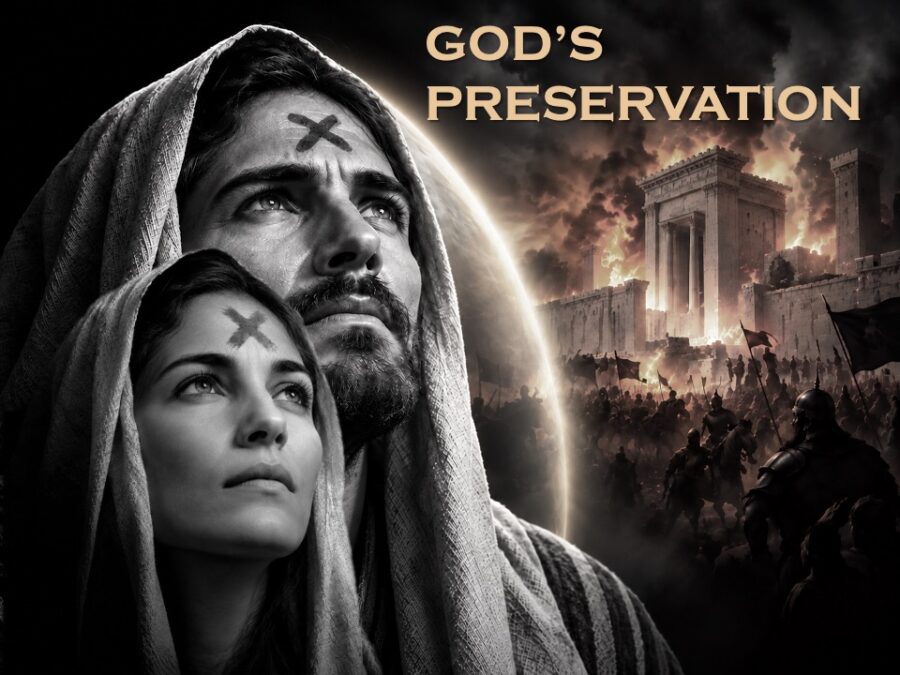
 One of the most intriguing biblical passages about a divine mark of preservation appears in Ezekiel 9:4. The scene is Jerusalem shortly before the First Temple’s destruction. Judgment is coming upon the city, but before it falls, God identifies a faithful remnant: “Go through the midst of the city, through the midst of Jerusalem, and put a mark on the foreheads of the men who sigh and cry over all the abominations that are done within it.”
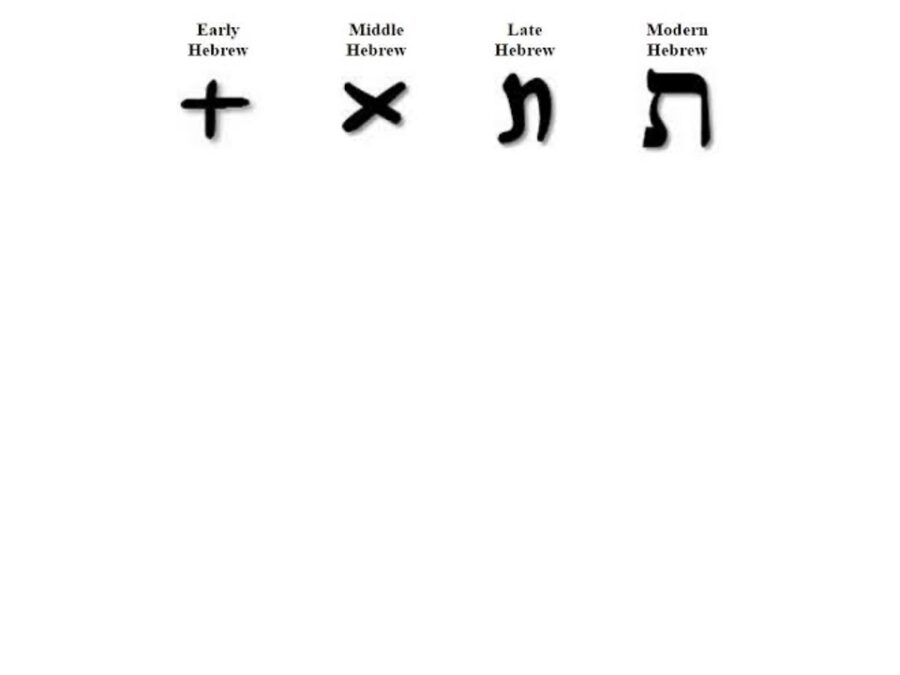
The Hebrew is particularly interesting: וְהִתְוִיתָ תָּו , vehitvita tav “and you shall mark a tav.” The word tav (תָּו) means a mark or sign, and Tav is also the name of the last letter of the Hebrew alphabet.
THE ANCIENT TAV
Today, the Hebrew letter tav is written ת, but this was not its ancient form. Ezekiel ministered during the early sixth century B.C., when the older Hebrew script, commonly called Paleo-Hebrew was still in use. In ancient Hebrew inscriptions, the letter tav could be represented by two intersecting strokes, resembling a slanted × or +. Therefore, Ezekiel’s original audience lived in a world in which the word tav could evoke a simple cross-shaped mark.
Nevertheless, from a Messianic perspective, the imagery is striking: before judgment falls, God’s faithful remnant is identified by a tav, a mark which in its ancient form could resemble a cross. Ezekiel 9:6 makes the mark’s importance explicit: “Do not come near anyone on whom is the mark.” The tav therefore functions as a mark of preservation amid judgment.
THE TAV AND PASSOVER
The connection becomes even more interesting because several important Jewish commentators compared Ezekiel’s mark with the blood of the Passover lamb. At the first Passover, Israel was instructed to place the lamb’s blood upon the two doorposts and lintel,“The blood shall be a sign for you on the houses where you are. And when I see the blood, I will pass over you.” Exodus 12:13. Abraham ibn Ezra (1089–1167), commenting on Exodus 12:7, compared the blood marking Israelite houses with the mark of Ezekiel 9:4. The point in both passages is essentially the same: a visible sign distinguishes those to be preserved when judgment comes. Ibn Ezra wrote: “The reason the blood was smeared on the window was to make atonement for all those eating in the house and to serve as a mark for the destroyer to see. It is to be understood in the same way as and set a mark on the foreheads of the men (Ezek. 9:4).”
David Kimhi (Radak, c. 1160–1235) likewise connects Ezekiel’s mark with the Passover blood.
Obadiah Sforno (c. 1475–1550) explicitly connects Exodus 12:22 with Ezekiel 9:4, explaining that the house was marked with blood, in a manner comparable to the command to place a tav on the people in Ezekiel. Thus, the Passover–Ezekiel connection is not merely a later Christian comparison; Jewish interpreters themselves recognized the similarity between the two events.
A REMARKABLE BIBLICAL PATTERN
Passover, Exodus 12
Judgment is coming.
A lamb is sacrificed.
Blood becomes the sign.
Those identified by the sign are preserved.
Jerusalem, Ezekiel 9
Judgment is coming.
A faithful remnant is identified.
A tav is placed upon them.
Those bearing the tav are preserved.
Revelation 7
Judgment is coming.
A remnant from the tribes of Israel is identified.
God seals His servants on their foreheads before judgment proceeds.
Here is the recurring biblical principle:
When judgment comes, God knows those who belong to Him and marks out His own for preservation.
THE TAV AND MESSIAH
For the Messianic believer, an additional, powerful visual connection emerges. The ancient tav could resemble a cross, while the New Testament presents Messiah’s death upon the cross as the means through which salvation is provided. Psalm 22, which believers in Yeshua understand as pointing prophetically to Messiah’s suffering, contains the remarkable description, “They pierced My hands and My feet.” Psalm 22:16
While Psalm 22 does not actually use the word tav, the relationship is thematic and visual: Passover blood, Ezekiel’s protective mark, and Messiah’s suffering all converge around the biblical themes of judgment, sacrifice, identification, and deliverance.
There is another beautiful Messianic association. The tav is the last letter of the Hebrew alphabet. Revelation describes Messiah as,“The Alpha and the Omega, the First and the Last, the Beginning and the End.” (Revelation 22:13). In Hebrew terms, this can naturally be expressed as the Aleph and the Tav, the first and last letters of the Hebrew alphabet.
WHY THIS MATTERS
The cross is sometimes presented as something foreign to the Jewish Scriptures. Ezekiel 9 gives us a fascinating reason to reconsider that impression. Long before the crucifixion, the Hebrew Scriptures already contained the remarkable picture of God’s faithful remnant being marked for preservation with a tav, a mark whose ancient form could resemble a cross, and Jewish commentators themselves connected that mark with the saving sign of the Passover blood.
One might never have imagined how deeply Jewish the imagery of the cross could be until one had read Ezekiel 9.