
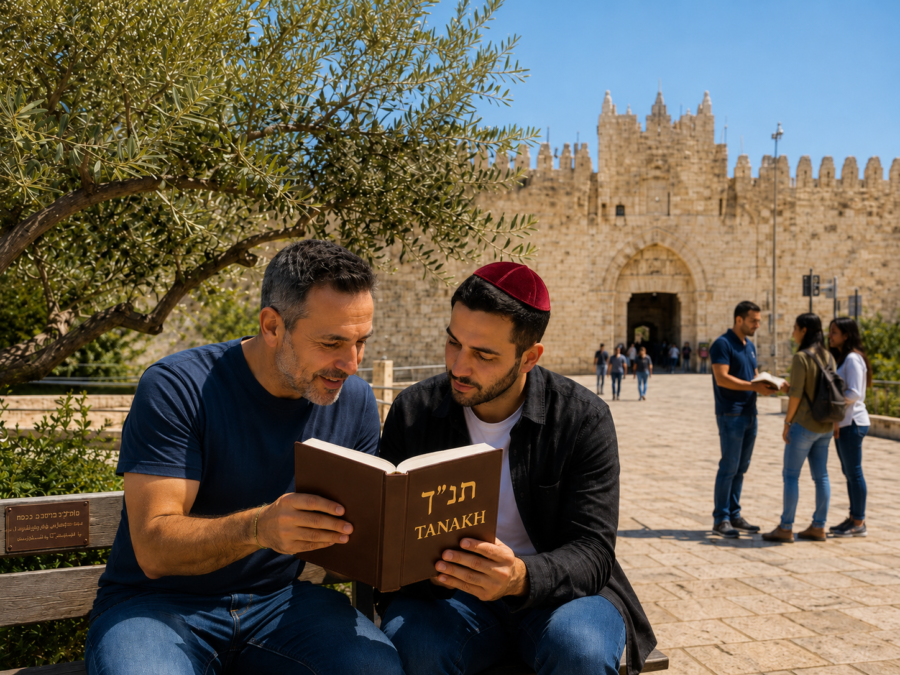
 For those who believe that the Church has replaced Israel and that Israel no longer has a role in God’s future plan, Romans 11 contains one of the New Testament’s strongest messages. It begins in vs. 13, where he turns directly to the Gentiles. He says plainly: “But I am speaking to you who are Gentiles…”
Paul is no longer merely explaining Israel’s condition. Here he warns Gentile believers about their attitude toward Israel. What does Paul anticipate they might say? Look at verse 19: “You will say then, ‘Branches were broken off so that I might be grafted in.’” What an extraordinary statement! Paul anticipates the very conclusion that would define centuries of Church history: Israel was removed so that they could take her place. And in Romans 11, Paul answers, in so many ways, with “no”!
In no uncertain terms, he tells them they were grafted in and should not become arrogant. They must not boast against the branches, consider themselves superior, or conclude that God is finished with Israel. Paul warned about this danger nearly two thousand years ago. That is what makes Romans 11 so remarkably relevant to the Church today.
What should the Church’s attitude toward Israel be today? Listen carefully to what Paul says in Romans 11:11, “I say then, they did not stumble so as to fall, did they? May it never be! But by their transgression salvation has come to the Gentiles, to make them jealous.” Here, Paul tells us something remarkable. Through Israel’s transgression, salvation has come to the Gentiles.
Even if the nation of Israel did not accept Jesus, the Gospel went out to the Gentiles through a Jewish remnant, making the Gentiles recipients of the spiritual blessings that came through Israel.
But what are Gentile believers supposed to do until then? Paul tells us right here in verse 11. And don’t miss this, because this is not merely Paul’s suggestion. These are words inspired by the Ruach HaKodesh. “Salvation has come to the Gentiles, to make them jealous.” That is part of the Gentile believer’s calling toward Israel, not to replace her, not to despise her, not to boast against her, but to make Israel jealous for her own Messiah.
What exactly does Paul mean by “to make them jealous”? Today, when we hear the word jealous, we usually think negatively. We think of envy, wanting what someone else has, or of fearing that someone we love may be taken away from us. But that is not what Paul has in mind here. Paul is describing a jealousy that awakens desire and zeal.
Imagine someone who has never known the peace of God watching another person endure a terrible trial with extraordinary peace. He may begin to think, “I want the peace that person has.” Or imagine someone who has never experienced a loving family being welcomed into a home filled with warmth, forgiveness, and genuine love. Something stirs within him as he says, “I wish I had a family like this.” Or think of a person who has spent years searching for meaning and then encounters someone whose relationship with God is so genuine, so joyful, and so compelling that he begins to say, “Whatever you have found, I want to know it as well.”
That is the positive side of jealousy. Now apply this to Romans 11. Paul says that when Israel sees Gentiles worshiping the God of Abraham, Isaac, and Jacob, reading Israel’s Scriptures, believing in Israel’s Messiah, receiving the spiritual blessings promised through Israel, and displaying the joy, peace, love, and hope that come through Him, something should stir within Israel. They should say, “These are our Scriptures. These are our promises. This is our Messiah. How have the Gentiles come to enjoy these blessings?” That is the kind of jealousy Paul wants the Gentiles to provoke.
And there is something fascinating even in the language. The ideas of jealousy and zeal are closely related. The Greek verb Paul uses here is παραζηλόω (parazēloō), built on the same ζηλ- (zēl-) word family from which we get words associated with zeal. We have seen that they already have zeal, but without knowledge; now you, the Gentiles, have the knowledge, so please share it with them to stimulate and increase this zeal for the Lord.
Paul brings us to one of the most important verses in this entire chapter. He is going to explain why Israel still matters to God and why Israel’s place in His purposes has not disappeared. He does it through two extraordinary illustrations contained in a single verse: The Dough or the challah, and the Olive Tree.
Romans 11:16 reads, “For if the firstfruit is holy, the lump is also holy; and if the root is holy, so are the branches.” There are two illustrations here: the first is about the firstfruit and the lump or the dough, which are set apart and holy. Let us begin with this illustration: What or who is the firstfruit and what or who does the lump represent? This is where Paul brings us to such a wonderful journey through the Torah and through history.
Concerning the Parable of the Dough. By the very words Paul uses, he takes us back to Numbers 15:17–21. There, when Israel entered the land, they were commanded to take the firstfruit of their dough and offer it to the Lord. The principle was simple: The firstfruit belonged to God. Because the first was set apart to God, it represented the whole. Paul takes that ancient command and applies its principle to Israel, “If the firstfruit is holy, the lump is also.”
Who are the firstfruits? Paul has just been speaking about the faithful remnant, and behind Israel stand the Patriarchs: Abraham, Isaac, and Jacob, set apart by God and recipients of His promises. So if the first is holy, set apart to God, then the dough that comes from it is also holy.
Paul’s point is not that every believing Israelite is automatically righteous; rather, it refers to the remnant of Israel, who today continue to proclaim the message of the Scriptures, as Abraham, Isaac, and Jacob did. And that brings us naturally to Paul’s second illustration: From the dough to the Olive Tree. What is the root? The root is the covenantal source of Israel’s holiness and blessing, the promises given through the Patriarchs and ultimately fulfilled in the Messiah. From that rich covenantal root, the branches receive their nourishment.
But now, what about the branches? Here, Paul becomes very specific. The natural branches are the Jews.
Some natural branches remain in the tree; these are Jewish believers in Yeshua.
Others are broken off because of unbelief; these are unbelieving Jews.
Go to the video – Romans 9-11- Part 6 -Did the Church Replace Israel