
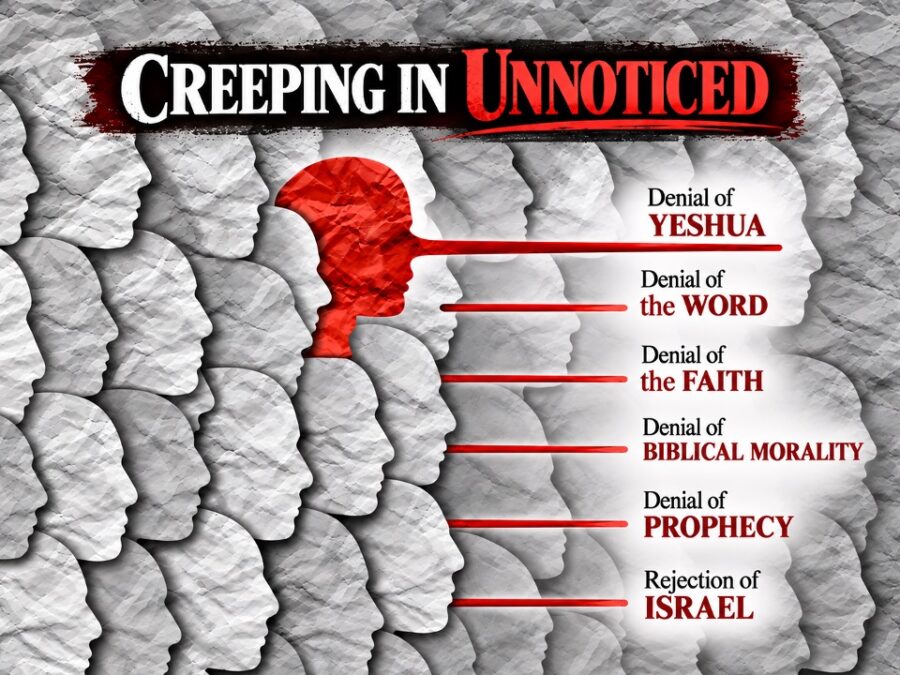
 We now turn to another remarkable dimension of biblical prophecy, one that points to God’s own congregation. What will its spiritual condition be as we approach the end of this age? What dangers will believers confront? What should we be watching for?
Scripture tells us much about these matters. Today, we begin studying a remarkable little book that speaks directly to these dangers with extraordinary urgency. Sefer Yehudah, that is, the Book of Jude. This letter was written nearly two thousand years ago, yet its warnings remain astonishingly relevant not only for Jude’s day but for ours as well.
In this short letter, Jude highlights one thing: the importance and seriousness of the biblical faith in the last days. He challenges us to examine the very foundation of our beliefs.
How strong is our faith in God? How deeply are we rooted in Yeshua? How firmly do we hold to the truth and authority of His Word? We will learn that this letter leaves no room for faith that compromises with sin, negotiates with falsehood, or even makes peace with those who would corrupt God’s truth.
Perhaps that is one reason this letter is so short, so concentrated, so extraordinarily intense.
There are only 25 verses! Approximately 461 words in Greek, a letter you can read in less than five minutes. Yet within those 25 verses, Jude takes us from Israel’s rebellion in the wilderness and the angels who abandoned their proper dwelling; from Sodom and Gomorrah to Cain, Balaam, and Korah; and from the days of Enoch to the judgment awaiting the ungodly. It is almost as though Jude has compressed centuries of divine warnings into a single letter. And perhaps we should be thankful it is no longer than this! There is scarcely a moment to recover from one warning before another arrives.
But as Jude encourages us to watch over our faith, he does so in the context of the end times. In this sense, the Book of Yehudah holds a unique place in Scripture. Within those few verses, Jude delivers one of the most urgent warnings about the last days. He emphasizes this by calling his readers to remember the words spoken beforehand by the apostles of our Lord Jesus the Messiah: “In the last time there will be mockers, following after their own ungodly lusts” (Jude 18).
Notice the expression the last time, it is especially significant. It reflects a deeply Jewish understanding of history and prophecy, rooted in the Hebrew Scriptures. Peter and the writer of Hebrews also used similar expressions, since these are messianic epistles. The idea goes back to Jacob and continues throughout the prophets, who spoke of the latter days, or the end of days, בְּאַחֲרִית הַיָּמִים (be’a-harit hayamim). Jewish believers were not unfamiliar with this concept. It was part of their prophetic heritage.
This letter also has something remarkable about its structure. Yehudah brings together a pattern of end-time warnings scattered throughout the New Testament. Taken together, these prophecies describe the congregation’s spiritual condition in the last days, conditions we can already see developing around us and increasingly within the evangelical church. They reveal what we might call a system of denials, a pattern that helps us understand what is happening to biblical faith today.
Why are they called denials? Because they deny God’s truth. We must understand something fundamental about evil: Evil is not an independent entity, and it cannot create truth. It can only deny, imitate, counterfeit, and corrupt what God has already established.
It begins by questioning what God has revealed. Then it twists the truth, corrupts what is holy, and disguises evil until no one recognizes the original truth. Where did this begin? In the Garden of Eden! The serpent did not introduce an entirely new revelation. He began by questioning the Word God had already spoken, planting doubt with the question, “Indeed, has God said?” Genesis 3:1
We will consider 6 major denials in this study: the denial of Yeshua Himself; the denial of His Word; the abandonment of faith; the rejection of biblical morality; the dismissal of prophecy; and the rejection of Israel’s place in God’s prophetic plan.
First Denial
Now, let me take you through these six great denials as we trace this remarkable pattern of end-time warnings in the Book of Jude. The first denial, and the first great attack, is directed against Yeshua Himself! It begins by minimizing His greatness, redefining His Person and divine nature, diminishing His authority, and ultimately denying Him altogether. Remarkably, this is the very first danger Jude exposes as he warns of false teachers infiltrating God’s congregation.
He writes in Jude 4: “For certain persons have crept in unnoticed… deny our only Master and Lord, Jesus the Messiah.”
Notice where the attack begins! Not at the edges of biblical faith, but at its very center! They strike at the highest authority, the very foundation of our faith, the Person of Yeshua the Messiah Himself. If they, who have crept in unnoticed, can undermine His identity, they can undermine everything else that rests on Him.
Let us move to the sixth and final great denial, one we see intensifying with alarming speed. It is the denial of Israel’s place in God’s prophetic plan. This is nothing new! Not long after John’s death, the last apostle, ideas spread within the Church that Israel had been replaced by the Church, that God’s promises to the Jewish people had been transferred to another people, and that Israel no longer held a unique place in His purposes. This became known as Replacement Theology and contributed to centuries of Christian antisemitism. Remarkably, many churches still embrace its forms today. According to the prophets, what began centuries ago will reach its terrible climax during the Tribulation. We can already see troubling signs of growing hostility toward Israel.
Now, Jude does not explicitly address this denial; perhaps he had not yet seen it. But Paul certainly does! This is a central concern in his teaching in Romans, particularly in chapters 9–11, where he defends God’s continued faithfulness to Israel and declares that “the gifts and the calling of God are irrevocable” (Romans 11:29).
Yet a principle in Jude speaks directly to this issue. In Jude 17–18, he writes: “But you, beloved, ought to remember the words that were spoken beforehand…”. Remember the words! Remember what God has already revealed! When we remember the Scriptures, how can we forget Israel? Israel stands at the heart of so much biblical history and prophecy, from Genesis through the prophets and into the New Testament.
Throughout Scripture, the Lord repeatedly identifies Himself as Israel’s God. The name Israel appears thousands of times, and this people’s history holds an extraordinary place in God’s revelation. How, then, can we claim to believe the Scriptures while dismissing the very people to whom God made His covenants and promises?
To forget Israel is to overlook a central part of God’s revealed plan. To deny His promises to Israel is to call into question the faithfulness of the God who made them.