
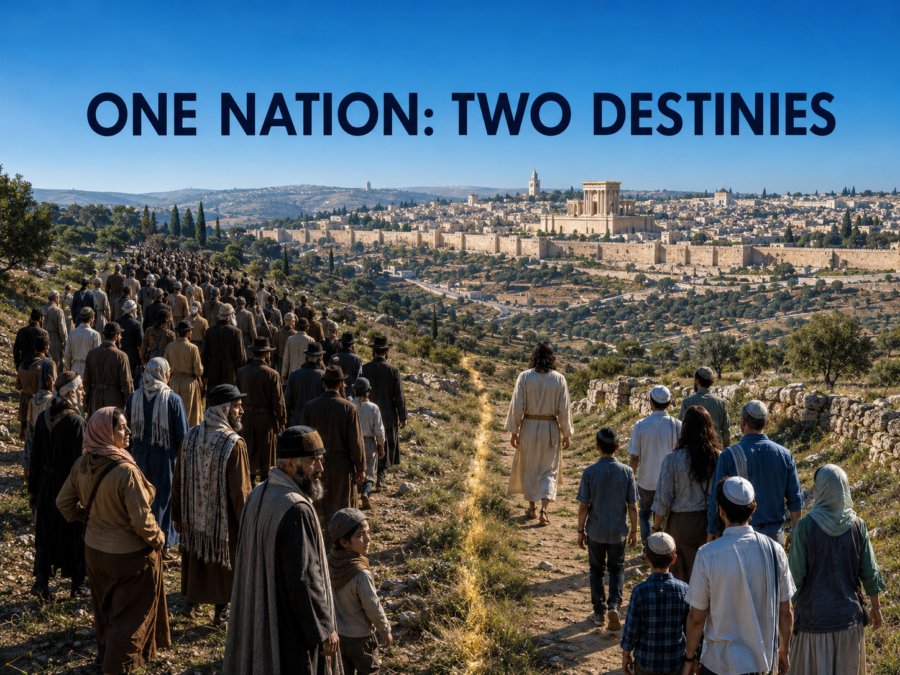
 What we notice toward the end of Romans 9 is that Paul further develops the concept of the Remnant within Israel, not by simply asking us to take his word for it, but by calling witnesses to the stand, beginning in verse 25.
And like a good Jewish lawyer, where does Paul find these witnesses? In the Hebrew Scriptures. He turns first to Hosea and then repeatedly to Isaiah. As we move into Romans 10, he continues to call upon Israel’s prophets and, most importantly for our study today, Moses and the Torah itself.
What follows, beginning with Romans 9:25, is a beautiful narrative of Israel through prophecy. From this point on, Paul cites seven quotations from two prophets, Hosea and Isaiah, which he cleverly weaves together to emphasize his point.
The first witness is Hosea. Paul begins in Romans 9:25–26: “As He says also in Hosea, ‘I will call those who were not My people, “My people,” and her who was not beloved, “beloved.” And it shall be that in the place where it was said to them, “you are not My people,” there they shall be called sons of the living God.’” Immediately we face an important question: Who are the people Hosea called, “not My people”?
Throughout Church history, many have answered it this way: It is the Gentiles; they say: they were not God’s people, and now through the Gospel they have become God’s people, the Church.
But there is a problem. That is not who Hosea was speaking about, nor are the other 6 quotations that follow. Go back to Hosea’s prophecy and read the entire sentence: “Yet the number of the sons of Israel will be like the sand of the sea… and it will come about that, in the place where it is said to them, ‘You are not My people,’ it will be said to them, ‘You are sons of the living God.’” Hosea 1:10
Who are Hosea’s ‘Not My People’? Hosea himself tells us: ‘the sons of Israel.’ There are many prophecies concerning Gentile salvation, but never in the Hebrew Scriptures were the Gentiles called “My people.” Hosea is describing Israel under judgment and, ultimately, restored by God.
Yet, significantly, even those who apply this passage to the Church generally do not go so far as to apply the next six or any of these quotations from the Hebrew Scriptures to the Church. Those passages are clearly understood as referring to Israel.
So, the two “peoples” are within Israel: the believing Remnant and the unbelieving majority. Yet both are part of Israel, and every individual Israelite shares in the national history of the whole.
This distinction is essential for understanding both Israel’s history and Israel’s prophetic future.
Paul’s argument is enhanced by Paul’s quotation from Isaiah the prophet who said in Romans 9:29,“Unless the Lord of Sabaoth had left us a seed, We would have become like Sodom, And we would have been made like Gomorrah.” Israel survived because God preserved a seed; a Remnant. And that Remnant has never disappeared. It existed in Daniel’s generation. It existed in Paul’s generation. And it exists in our generation.
Who is the remnant of Israel today? Among that Remnant are Jewish believers in Yeshua, the Messianic Jews, descendants of the nation of Israel who have recognized their Messiah while remaining part of this peoplehood. The community of Messianic Jews is living proof that God is still at work within Israel. Their existence today is also a living testimony to the words of Paul, “Even so then, at this present time there is a remnant according to the election of grace” (Romans 11:5). Today’s Remnant is evidence of God’s faithfulness to Israel. And the God who has preserved a Remnant throughout Israel’s unbelief is the same God who will one day fulfill every promise He has made to the nation.
But what was the problem with the vast majority within Israel? How did the people stray so far from God? Paul explains it. At the end of Romans 9, Paul weaves two prophecies from Isaiah 28 and Isaiah 8 and says, “They stumbled over the stumbling stone, just as it is written, “Behold, I lay in Zion a stone of stumbling and a rock of offense, And he who believes in Him will not be disappointed.” Romans 9:32b-33.
Here is something remarkable. In Isaiah’s original prophecy, the Stone is not merely a doctrine or an idea; the Stone is the Lord Himself – the Lord of hosts. We can see how Isaiah and Paul divide Israel in two: To one group within Israel He, the Lord of hosts, is a sanctuary, and to those for whom He is a rock to stumble over.
But how could the Lord Himself become such a stumbling block to the majority of the very people He chose to carry His Word? Perhaps the extent of this saying is seen in the leadership of Israel rejecting the Messiah Himself. Few realize the full extent of their rejection of the Savior of Israel. For the believer, God is our sanctuary, our miqdash; this is how the Tabernacle was called, and access is open to all who have made Yeshua their Savior.
Go to the video – Romans 9-11- Part 4 – From Torah to Messiah