 Leviticus 16 is one of the most unusual chapters in the Torah. Throughout Scripture, God often reveals His truth progressively, piece by piece, drawing the careful reader deeper into His Word. But in Leviticus 16, the details are especially striking.
Here we encounter an extraordinary sacrifice involving two goats: one is placed on the altar for sacrifice, and the other is a mysterious goat sent alive into the wilderness to a being named Azazel. As the goat disappears into the wilderness, something unusual happens. The story suddenly stops. The text tells us nothing more. Why? Where is the rest of the story?
But before the goat, let us examine the High Priest’s role. On Yom Kippur alone, he was permitted to enter God’s presence, and he did so under some of the most stringent regulations. For instance, the Talmud says that seven days before Yom Kippur, the High Priest was moved to a special apartment in the Temple to rehearse, over and over, all the required actions. They feared he would be struck dead, as Aaron’s two sons were in Leviticus chapter 10.
During the night before the Eve of Yom Kippur, they kept the High Priest awake all night, fearing he might be defiled by dreams. To prevent the High Priest from dozing off, see what they did to him: I quote from the Talmud: The other priests would keep him awake by snapping their fingers, without touching him, and if he could not keep his eyes open, they made him walk on the cold pavement of the Temple courtyard. M. Yoma 1:1-7. That is enough to wake a person, for it is cold at night in Jerusalem in September and October.
And tired or not, he needed to be ready for the Day of Yom Kippur itself. On this day, the Torah required the High Priest to undergo five changes of clothing, complete immersions, and ten washings of the hands and feet because he had to enter the Holy of Holies four times during the day, and each entry required a full ceremony.
Beyond this most sacred ceremony, we find more intrigue as we investigate the chapter further. See how the text places tremendous emphasis on the Sin Offering (chatat). It appears ten times in eight verses, as though the text is calling our attention to it. But perhaps this emphasis also makes us notice something else: the complete absence of another important sacrifice, the asham (Guilt Offering), often mentioned alongside it. The ancient rabbis noticed this absence. They recognized that Yom Kippur did not simply eliminate the obligation to bring an asham. The Talmud states that one liable for such an offering before Yom Kippur remained “liable to bring [the offering] after the Day of Atonement.” b. Keritot 25a.
The asham dealt particularly with guilt that required repayment and restitution. It carried not merely the idea of sin needing forgiveness, but of liability, something owed that had to be made right. In many cases, restitution was required alongside the sacrifice. If the asham sacrifice is absent, how will the restitution for sin be accomplished? Once again, we find ourselves in a chapter charged with Messianic significance. Remarkably, what appears mysterious in the ceremony begins to come together in the person and work of the Messiah. The chapter leaves us searching, but ultimately points us to Him.
The sacrifice missing from Leviticus 16 (asham) suddenly appears by name in that great Messianic passage of Isaiah 53:7-9, “He was oppressed and He was afflicted, like a lamb that is led to slaughter…”. “He was cut off out of the land of the living…”. And why did He die? “For the transgression of my people…”
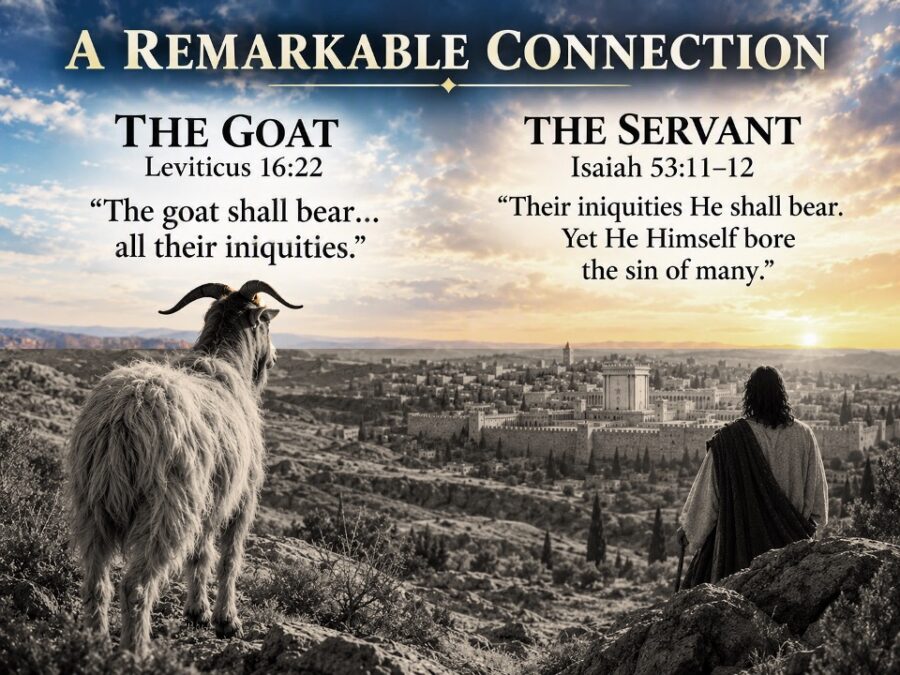
And then we read Isaiah 53:10, “He would render Himself as a guilt offering.” Here we have the Hebrew word אָשָׁם, asham. The very offering absent from the ceremony of Yom Kippur in Leviticus 16 is placed upon the Servant Himself in Isaiah 53. So it is the goat of Leviticus 16 that points us forward to the missing asham. The answer is found in the Messiah. He bears the sin. He bears the guilt. He pays the debt owed. This is how impeccably Yom Kippur points us to Yeshua.
But something else is very powerful here: the tradition of the red ribbon, which the Talmud called לָשׁוֹן שֶׁל זְהוֹרִית, lashon shel zehorit, literally, a crimson tongue. During the Yom Kippur service (in the Second Temple period), the goat that carried away Israel’s sins wore a red ribbon on its horns. A second ribbon was also nailed at the door of the Temple. Now here is what is so fascinating. The Talmud itself states that this red ribbon, which normally changed to white, indicating God’s forgiveness, no longer did so since 30 AD, 40 years before the destruction of the Temple. What happened at that point? Yeshua was crucified, died, and was resurrected. All forgiveness was now found in Him and through Him.
Now consider what happened in the Book of Acts when the Spirit, the Ruach HaKodesh came on the believers. “Then there appeared to them divided tongues, as of fire, and one sat upon each of them”. Acts 2:3
The many disciples of Yeshua must have made the connection; they were used to seeing the red ribbon in the form of tongues every Yom Kippur on the door of the Temple, but since Yeshua’s great work of final atonement, it was now the Spirit Who came reminding them that their sins are forgiven forever. This same word, lashon (tongues), was used by the rabbis to describe the crimson ribbon and by Luke to describe the tongues of fire on the disciples. What the rabbis looked for in the crimson tongue (ribbon) now transferred to those tongues of fire on the disciples. And a most wonderful thing is that even in their own writing, the Lord has left clues and signs here and there to bring back His people to Himself.