
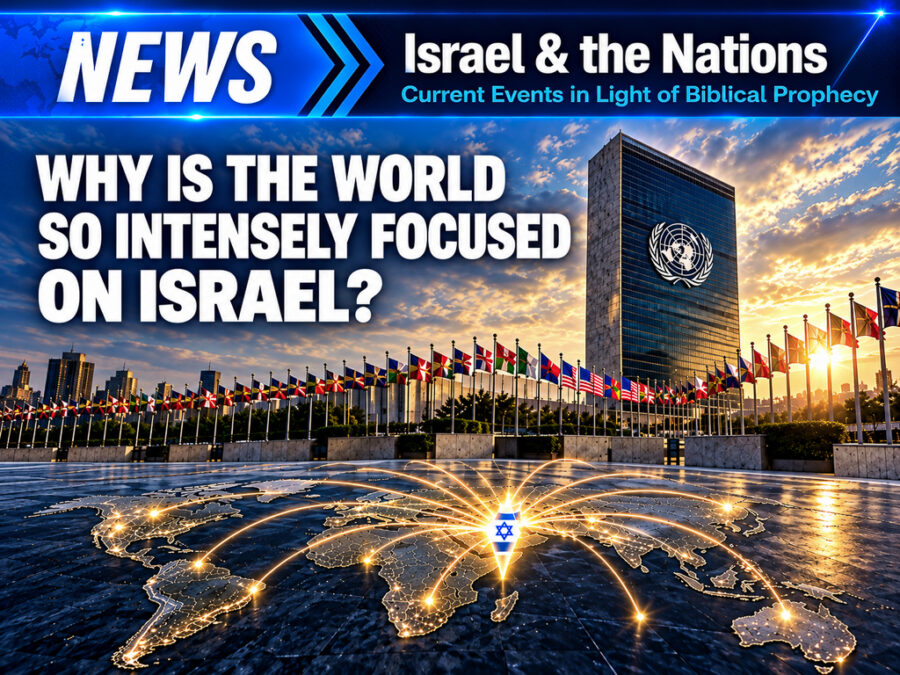
 Why is the world so intensely focused on Israel? We have raised this question before, but we cannot afford to set it aside. Instead, we must return to it with even greater urgency. The world’s attention on Israel is not diminishing; it is intensifying.
Throughout 2025 and into 2026, we have witnessed Israel facing growing diplomatic isolation, mounting international pressure, and increasingly strained relations with the international community. What makes this development particularly significant is the source of much of this pressure. It is not simply coming from Israel’s traditional adversaries. It is also coming from countries that, for decades, have maintained friendly relations with the Jewish state, including Western democracies, European governments, and other historically close partners to Israel.
Alongside these developments, we are witnessing something equally troubling: mounting hostility toward the Jewish people and a disturbing rise in antisemitism.
Now, let me ask you something. Did you follow the 81st session of the United Nations General Assembly this past September? Did you notice how much international attention was focused on Israel? Country after country took the floor, and criticism of the Jewish state became a recurring theme. Of course, these nations have different concerns and political motivations. But seeing so many countries focus on one small nation was deeply unsettling.
What is striking is not only that Israel was mentioned by so many speakers, but also how much of their national addresses were devoted to criticizing this small nation. Israel represents only about 0.2% of the world’s population, yet in some speeches, criticism of Israel took up nearly half the speaking time. Consider as well that President Erdoğan of Turkey reportedly devoted approximately 50% of his address to Israel, as though half the concerns of that large nation revolved around tiny Israel!
King Abdullah of Jordan and the Emir of Qatar reportedly devoted about 45% of their speeches to Israel, while leaders from Spain, France, Britain, Iran, Syria, Indonesia, Malaysia, and Pakistan, among others, devoted 20% to 30% of their addresses to the subject. Even the President of the General Assembly specifically highlighted Gaza as one of the conflicts repeatedly discussed throughout the six-day gathering.
But perhaps the most revealing moment came when Israel’s Prime Minister, Benjamin Netanyahu, rose to address the Assembly. Reports indicated that representatives from nearly 70 countries protested by walking out or leaving their seats empty. This was not the first time such a protest occurred. Similar walkouts occurred in 2024 and 2025, with approximately 50 countries participating in 2025. Now, in 2026, the reported number had risen to nearly 70. What an extraordinary scene at an institution established to promote dialogue among nations!
But that is not all! The Los Angeles Times reported that the Palestinian Mission to the UN had sent a prior message to many countries, urging them to bring as many staff members as possible so that, when they walked out together, it would paint an exaggerated picture of discontent with Israel. Israeli Ambassador Danny Danon explained that only one representative usually attends a particular UN speech. In this case, delegations from Qatar, Pakistan, Turkey, Saudi Arabia, Sudan, Yemen, Syria, and Oman, among others, filled an unusually large number of seats during the speech before Netanyahu’s. When Netanyahu came on, so many left together. They say birds of a feather flock together. Well, at the UN that day, the more feathers, the more dramatic the departure. In fact, every empty chair became part of their theatrical performance.
While so much attention was directed toward Israel, what about the other devastating conflicts around the world? We know there are many. Just two weeks ago, on October 7, the UN reported that more than 200,000 Yemenis had been displaced as fighting raged, up from the 76,000 reported in mid-September. Where is the same outrage? Where is the same urgency? Sadly, the news media often gives these tragedies far less attention.
And as if to underscore the growing international scrutiny of Israel, consider what happened on October 9, barely a week ago. The 2026 Nobel Peace Prize was awarded to Navi Pillay, the former United Nations High Commissioner for Human Rights. An extraordinary honor, one of the world’s most prestigious awards! But why is this choice so significant? Because Navi Pillay is also among Israel’s most prominent international critics.
Between 2021 and 2025, she chaired a United Nations Commission of Inquiry investigating Israel and the Palestinian territories. Under her leadership, she repeatedly accused Israel of committing genocide in Gaza, an accusation Israel has vehemently rejected. Throughout those years, the Israeli government repeatedly challenged her impartiality, accusing her of persistent bias against the Jewish state. And now, the very woman whose investigations and conclusions Israel has so strongly contested has been awarded the Nobel Peace Prize! This is another striking development in the growing international isolation and persecution of Israel.
Where are we headed with Israel’s growing isolation? Let’s not be blind to the unfolding pattern. This is increasingly clear. For those who believe in God, His Scriptures, and Yeshua the Messiah, these developments call to mind some of the Bible’s most solemn prophecies about Israel and the nations in the end times.
And consider this other ongoing news: at this moment, these nations are dividing the Land of Israel. In a vote at the UN in Sept. 2025, 74% of the nations voted for a two-state solution, asking Jews to give up territories. But the Lord says that this land is His. When He saw how the enemies of Israel were dividing the land for themselves, He said in Ezekiel 36:5, “Surely in the fire of My jealousy I have spoken against the rest of the nations… who appropriated My land for themselves…”
What makes this prophecy so remarkable is its placement in Ezekiel. It appears immediately before the great prophecies of Israel’s restoration, culminating in Ezekiel 37: the vision of the Dry Bones coming together, which we understand as pointing to Israel’s national rebirth in 1948.
But notice something extraordinary! Before Ezekiel describes Israel’s restoration, the Lord speaks of the nations dividing Israel’s land! God does not treat it as just another piece of territory to be negotiated, divided, or distributed among the nations. He calls it “My Land”! The nations may dispute its ownership, draw their boundaries, and seek to divide it according to their own purposes, but the Lord reminds them of an unchangeable truth: The Land belongs to Him!
The Lord also said in Isaiah 29:7 that at that time, a multitude of nations will wage war against Jerusalem (Ariel). Is this not what they are doing now?
He spoke through Micah and said in 4:11 that before the Messiah comes, many nations will assemble against Him and say, “Let her be defiled, and let our eyes triumph and taunt over Zion.” This sounds so much like what they did at the UN, where, in one voice, they spoke against the nation of God. Hasn’t the Lord clearly said that before Yeshua returns, He will gather all the nations against Jerusalem to battle, and the city will be captured… Zechariah 14:2. The UN’s diplomatic criticism of Israel foreshadows the military criticism yet to come, when they will be physically against Jerusalem and in open conflict.
Scriptures have long revealed that Israel holds a remarkable place in God’s unfolding prophetic plan. Let us thank God for the extraordinary revelation He has given us in His Word! As we read these prophecies and watch the news, we are filled with awe at the greatness of God, who knows the end from the beginning. Rather than being overcome by fear or uncertainty, we can rest securely in Him, knowing that history is not beyond His control.
Click here for the Video: Israel and the Nations – Why is the world so intensely focused on Israel?