
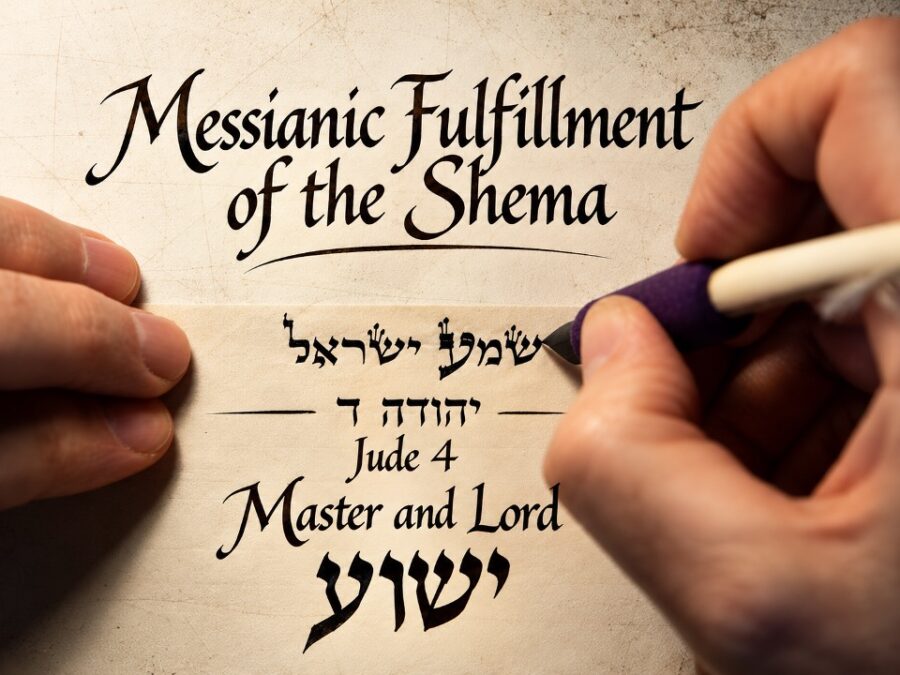
As we explore more of the book of Jude, we ask: What troubled Yehudah so deeply? What danger was so serious and alarming that he could no longer remain silent? Listen carefully to his words. In verse 3, Jude tells us he felt the necessity to write, using a strong Greek expression that conveys a sense of obligation. This was no casual decision. He felt constrained and deeply moved to sound the alarm! So he writes with urgency and haste, as he indicates in verse 3.
What could have been so serious that Jude felt such an overwhelming obligation to speak? The answer lies in a single verse, verse 4, which is more than an introduction to the problem. It is the headline of the entire letter! Jude 4: “For certain persons have secretly slipped in among you, those who were long beforehand marked out for this condemnation. They are ungodly people, who pervert the grace of our God into a license for immorality and deny our only Master and Lord, Jesus the Messiah.”
In just a few carefully chosen words, Jude exposes the danger that will dominate the rest of his message. Here, Jude reveals four disturbing truths about those who have infiltrated God’s congregations. Everything that follows flows from this one extraordinary verse.
First, he tells us how they enter the congregation. They slip in secretly, concealing their true identities and the danger they pose, and appear to belong among the believers while pursuing a different agenda.
“They creep secretly.” Remarkably, a single Greek word conveys this expression, found only here in the New Testament, which adds to the significance of Jude’s warning. This word, once again, brings us right into the battlefield. A closely related Greek verb means to secretly introduce or bring something in. In his Historical Library (12.41), the Greek historian Diodorus Siculus describes traitors secretly bringing soldiers inside a city’s walls, enabling them to seize control. This is precisely the danger Jude warns about.
And here is something even more troubling: many of these individuals may not fully recognize the spiritual forces at work behind their actions. This is not merely a human problem. This deception also has a spiritual dimension.
Second, Jude tells us who they are in God’s sight. They have been “long beforehand marked out for this condemnation.” They may have entered the congregation unnoticed by men, but God never hid them! So, if we stay close and connected to God through prayer and His Word, we have little to worry about. We should be able to spot them by comparing their words with the Word. Infiltrating and corrupting what belongs to God is no small matter. Heaven does not take lightly those who seek to undermine His congregation. These are not like those outside who openly speak ill of God, Jesus, and the Bible. These at least raise their flags, and we easily identify them. However, Jude is speaking about those who do it secretly.
Third, Jude tells us what they do. He declares that they “pervert the grace of our God into a license for immorality.” How do they do that? They take one of the Gospel’s most precious truths, God’s grace and forgiveness, and twist it into a justification for sin! They argue that because God is gracious, they may continue in immoral behavior without fear of judgment.
To convey the extraordinary seriousness of their actions, Jude lists 24 descriptions of these false believers, all within a letter of just 25 verses. In it, Jude examines their beliefs, exposes their behavior, unmasks their motives, condemns their rebellion, announces their coming judgment, and leaves no part of their character unexamined.
Fourth, and of utmost importance: he points out their ultimate goal. Yehudah says they “deny our only Master and Lord, Yeshua the Messiah.” This is the seed of the danger! Whether through their teaching, conduct, or rejection of His authority, these individuals undermine Yeshua’s true identity and sovereign lordship. Once the biblical understanding of Yeshua is corrupted, the congregation’s foundation is threatened. When people undermine the Messiah’s person and authority, everything else begins to crumble.
But here Jude makes an extraordinary declaration: the very words he uses to describe Yeshua proclaim the Messiah’s identity, His divine nature, and sovereign authority. This creates what we may call a Messianic expression of the Shema. For first-century Jewish listeners, as for Jewish readers today who know the Shema, these words echo the confession at the heart of Israel’s faith: YHWH alone is God, and to Him alone belongs our undivided allegiance. Jude’s language places Yeshua at the very heart of that allegiance.
For those unfamiliar with the Shema, it is recited each week in this congregation during the blessing of the children. It comes from Deuteronomy 6:4, which declares: “Hear, O Israel! The Lord is our God, the Lord is one!”
What makes the Shema so special? By the first century, the Shema had already become one of the central confessions of Jewish faith, proclaiming the oneness and exclusive sovereignty of the God of Israel. Its words were so deeply rooted in Jewish religious life that reciting them each morning and evening was already established, in accordance with the command in Deuteronomy.
When Yeshua was asked which commandment was greatest, He began with the Shema.
In Mark 12:29, we read: “Jesus answered, ‘The foremost is, Hear, O Israel! The LORD our God is one LORD.’” When we compare these two passages, Deuteronomy 6:4 and Jude 4, we see that the exclusive sovereignty Israel confesses regarding YHWH is expressed here in relation to the authority of Yeshua the Messiah.
Notice the names and titles. The names of God in the Shema occur three times, namely Lord, Adonai, and Lord. Likewise, Yeshua has three titles: Master, Lord, and Messiah, along with His name. These two Greek titles, Despotes and Kyrios, would have been familiar to Jewish readers acquainted with the Greek Scriptures, the Septuagint, since they correspond to the very names Lord and Adonai in the Shema; we see this in Isaiah 1 and 3.
The Hebrew calls Him: Ha-Adon YHWH , the Sovereign LORD. In the Septuagint we read:
Despotes Kyrios, the same as we see it in Jude 4. Think of the significance! The Scriptures’ titles for the sovereign God of Israel are now applied to Yeshua, whom he calls the Messiah.
But this is not all! Consider the word “only” in Jude and the word “one” in the Shema. Both point to God’s exclusive identity and sovereignty. In Jude, the Greek word is μόνος (monos), meaning only, alone, without another. In the Shema, the Hebrew word is אֶחָד (echad), meaning one.
But note that in the Shema, the word is echad, which, by definition, is a compounded union. It is not yachid, which means one and only one, but echad, meaning one among others. Echad leaves room for the name of the Messiah, which Jude provides as he completes the Shema by giving the name of the Messiah of Israel: Yeshua the Messiah.
Another Greek word also deserves our attention. It is a small word that is easily overlooked in translation. It is the Greek definite article: τὸν, ton, or the. It is singular and introduces the description of Yeshua as Master and Lord. The Greek literally reads, “The only Master and Lord, Jesus Christ.” The grammatical construction naturally leads us to understand both titles as referring to one person: Yeshua the Messiah.
Jude 4 may therefore be understood as a messianic confession of the Shema, that is, of exclusive divine lordship, one that resonates with Israel’s Shema and applies to Yeshua, using language associated with the unique sovereignty of the God of Israel. To Jude’s original readers, these final words must have carried tremendous weight.
Go to the video – Jude Part 3 : Can You Believe in God and Still Deny Him?