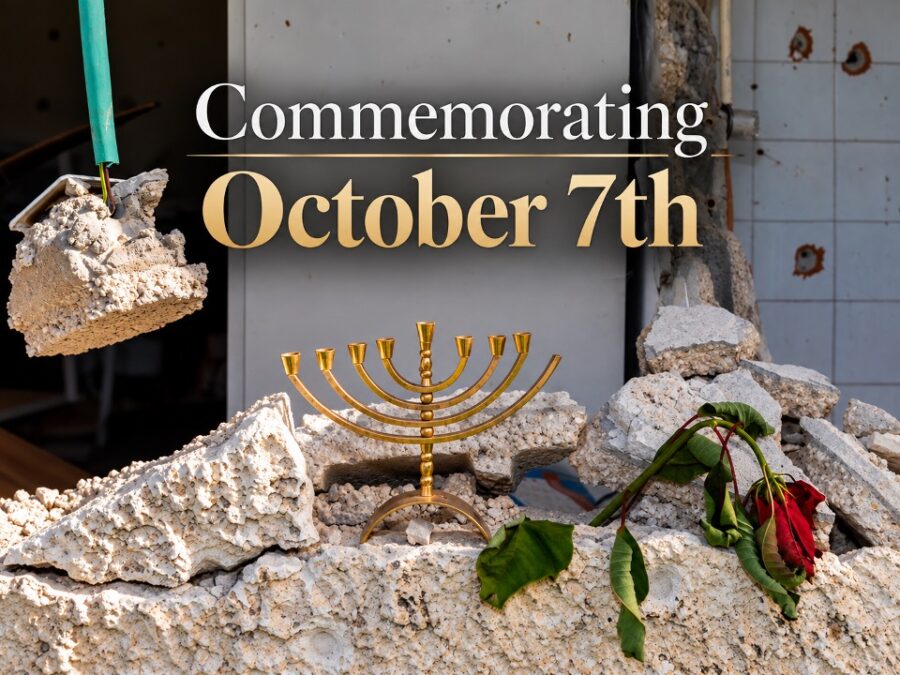
 Today marks three years since October 7, 2023. So much remains to remember that it is difficult to know where to begin.
We remember the more than 1,200 lives lost. We remember the 251 people taken hostage. We remember families shattered in hours. And we remember extraordinary acts of courage, by soldiers, police officers, security personnel, and ordinary civilians who suddenly found themselves doing extraordinary things to save another human life.
Numbers and statistics speak volumes, but stories like the one that follows are the reason the numbers become so personal.
Among them is the story of photojournalist Roi Idan and his wife, Smadar. Their three children were Michael, Amalia, and little Abigail. On October 7, their parents were killed. Smadar was shot and killed in the house, protecting her two children. Michael and Amalia survived by hiding in their home for hours. The father, Roi, was also killed by the terrorists, but somehow, he managed to get little Abigail to the neighbor’s house. Eventually, she was taken to Gaza by the terrorists, but she was released and reunited with her family. The children are being raised by the aunt and uncle.
These three children survived, but they would grow up without their mother and father. And theirs was not the only family. In the immediate aftermath of October 7, 116 children were reported to have lost at least one parent: 20 of them losing both parents. And that stat is just from Oct 7th.
Behind every statistic is a bedroom with someone missing. A chair at a table, empty. A child whose life will forever be divided into before October 7 and after October 7. For many in Israel and Jews abroad, Oct 7th is a defining point in time, pointing to yet another great birth pang in these end days.
The wounds did not end on October 7th, nor did the suffering. Hundreds of thousands of Israelis were displaced from communities in both the south and north. At one point, estimates put the number who had evacuated their homes at more than 250,000. Families lived in hotels and temporary accommodations; children attended unfamiliar schools; farms and businesses were left behind.
Some wounds are visible; others are not.
As of this week, Israel’s Defense Ministry reports that approximately 30,000 wounded IDF soldiers and security personnel have entered its rehabilitation system since the war began. More than half are dealing with psychological reactions, including PTSD, anxiety, depression, and difficulties returning to civilian life.
After three years, many Israelis are still living October 7th.
And another wound appeared almost immediately: the eruption of antisemitism around the world. For many Jewish people, one of the most bewildering experiences was how quickly the conversation shifted. Israel had barely begun to bury its dead when arguments already appeared seeking to justify, minimize, or deny what had happened. The victims were quickly reframed as the aggressors. According to Human Rights Watch, within 24-48 hours after the attack, even before Israel launched its own attack on Gaza, online and social media rhetoric denied that this was a war crime and instead justified it as an act of resistance by Hamas. How many academic circles chose to hold Israel accountable for the terror and tragedy, arguing that the victims brought this violence upon themselves? There have been record-breaking statistics on antisemitic incidents, the highest levels the ADL has ever recorded. 300-400% surges were recorded in Canada, Australia, the UK, and France. There was firebombing of synagogues and shootings at day schools. There were physical assaults and violent harassment of Jews who wore visible symbols of their faith.
For Jewish communities around the world, it became a reminder that an ancient hatred had not disappeared.
And speaking of our future commemorations, they are founded in the Scriptures’ promises, which do not deny that these things will come to pass, but give us a clear lens on the future hope of restoration. While suffering is great and will continue to rise, we know justice will prevail.
And it is our responsibility to comfort Jewish people in many ways. Letting them know they are loved and cared for by the God of Israel can be a great comfort, coming side by side with them in their sorrow, giving financially, serving, and praying for them. And when God gives us the opportunity, we tell them that the God of Israel has neither forgotten nor abandoned His people.
And ultimately, we share with them the greatest hope we possess, the hope of Messiah Yeshua.
We recognize the eternal hatred given to us in Psalm 83, but we will forever stand on the guarantee of preservation from Jeremiah 31:35-36. One day, we must point out to our Jewish friends that, at the end, when Messiah returns and peace will be restored, we will experience Micah 4:4’s words: that “… everyone shall sit under his vine and under his fig tree, and no one shall make them [Jewish people] afraid.”