 What is Sukkot, the Feast of Tabernacles, about? Sukkot is the seventh and final feast of Israel mentioned in the Torah (Leviticus 23), and it brings the cycle of the biblical feasts to a magnificent conclusion.
The Hebrew word for seven is sheva, a word associated with fullness and completion. Within the same Hebrew word family, we find Shabbat, the Sabbath, the great biblical picture of rest. It speaks to one of the deepest longings of the human heart: a day when humanity will finally dwell in peace and harmony with one another, with creation, and, above all, with God Himself. It points us toward the world as God intended it to be. It reminds us of the many prophecies concerning the coming age of peace, something our world desperately needs today.
One of these great prophecies is found in Isaiah 2:2, containing words we often sing during worship: Now it will come about that in the last days, The mountain of the house of the LORD Will be established as the chief of the mountains, And will be raised above the hills; And all the nations will stream to it.
These are words still awaiting fulfillment. Never have the nations of the world, as one, worshipped the one true Lord. Never have the nations, together, streamed toward Jerusalem to worship God. And what a contrast with what we see today! The nations are gathered at the United Nations for the 81st General Assembly, and we hear accusation after accusation directed against Israel. Leaders from France, Britain, Spain, and other nations have used some of the strongest language possible, including allegations of genocide, apartheid, and ethnic cleansing. But the Bible tells us that the present situation is not the end of the story.
The Lulav
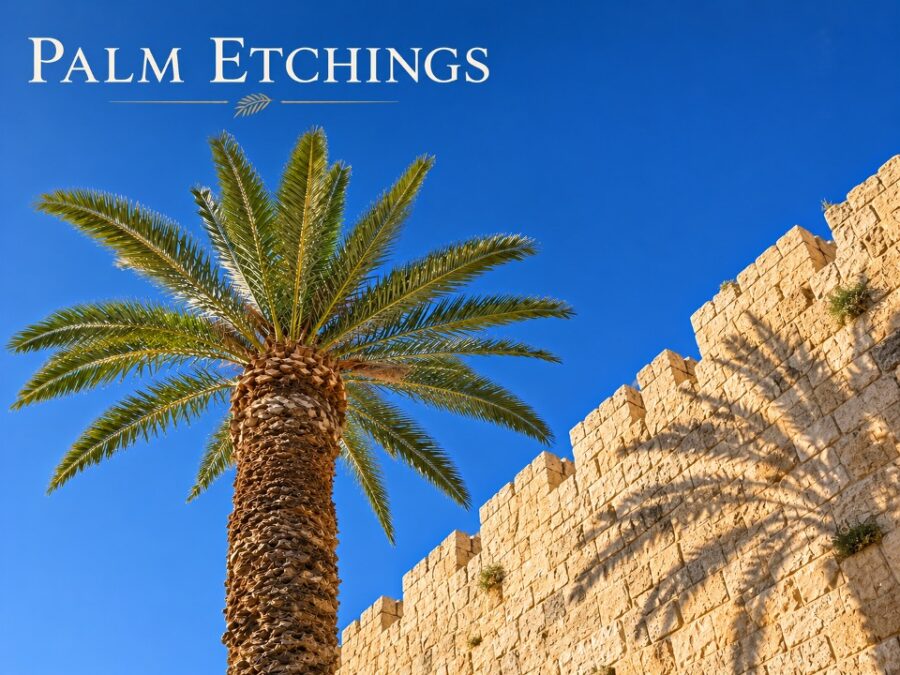
One commandment connected with Sukkot takes this expectation even further and fills the feast with anticipation of God’s coming Kingdom. It is the beautiful mitzvah (commandment) of the lulav. During Sukkot, the Jewish people are commanded to take, bind together, and wave the four species. The word lulav originally referred to a young shoot and came to designate the palm branch in particular. Together with it are two willow branches, aravot, three myrtle branches, hadassim, and the fruit from the citron tree, the etrog, with its beautiful fragrance.
It is quite remarkable, then, how the palm tree (representing the lulav since it is a palm branch) becomes the major carved image in the entire temple interior (Ezekiel 41:17-20). Ezekiel’s temple is then directly connected to the fulfillment of Sukkot, the Millennial Kingdom.
Millennial Times
The last nine chapters of Ezekiel must be among the least-read in the Bible, perhaps because they can be difficult to read and, at times, even harder to understand. In fact, some of the ancient rabbis recognized how difficult Ezekiel was and concluded that some of its mysteries would have to wait until Elijah arrived to explain them.
What Ezekiel gives us is essentially the blueprint for an enormous Temple, described in extraordinary detail. This Temple is unlike anything Israel had ever built. It resembles Solomon’s Temple in certain ways. There are priests, sacrifices, gates, courts, and an altar. Yet when you look carefully, it is not Solomon’s Temple. Some familiar elements are missing, and others are different. The arrangement of worship is different.
The land’s distribution must also be noted. The tribes of Israel are rearranged. Dan is first in the north. Zebulun, once associated with the north, is now in the south. The tribes do not simply return to their ancient territories. Something new is happening here. And immediately, the questions begin: What is this Temple? Why this new arrangement for Israel? And perhaps most difficult of all: Why are animal sacrifices offered again? We know that Yeshua offered the final and sufficient sacrifice for sin. So what do these sacrifices represent?
Those are important questions, but before Ezekiel answers many of them, he does something that can test the patience of even the most devoted Bible reader. He starts measuring things! After a brief introduction, verse 5 turns to the exterior walls. Then we enter the Temple through the eastern gate. Seven steps to the first gate, eight to the second. And then, more measurements! One commentator described these chapters as a “labyrinth of confusion.” Another said the reader is left in a maze.
These may be among the most beautiful chapters in the entire book. So why all the confusion? Remember when Yeshua turned water into wine at Cana? The master of the feast said the best wine had been saved for the end. In a similar way, Ezekiel has kept something magnificent for the end.
Let’s consider ourselves for a moment in the time when Ezekiel gave the blueprint for the Temple. The exiled Israelites had been in Babylon for at least 25 years. Think of what the Jewish people must have been thinking. Their city had fallen. Their Temple had burned. Many had already been carried into exile. Everything visible seemed to say: It is over.
And then Ezekiel stands among these exiles and begins describing a new Temple. Not vaguely. He measures it! Suddenly, every measurement becomes a song, a symphony of hope that says: God is not finished with Israel. This is when every cubit becomes a block of hope. You can almost walk through this Temple with Ezekiel.
As we follow him, notice the path he takes. Step by step, vision by vision, he leads us forward, as though everything is moving toward one great destination, the culmination of the entire vision and its divine climax.
This is what all those measurements have been preparing us for. Ezekiel looks east and suddenly recognizes something. “Behold, the glory of the God of Israel came from the way of the east. His voice was like the sound of many waters; and the earth shone with His glory.” 43:2. The Rouah HaKodesh has returned to Israel, and Ezekiel recognizes Him! This is the same glory he had seen earlier, the glory of God that had departed from Jerusalem because of Israel’s sin, as described in chapters 10 and 11.
But the excitement does not end here. Once the presence of God is present, something begins to move outward from God toward the world: We see movement from the Temple to the River to the Land, to the Tribes, to the Sacred District, and then to the City. This is not simply a story about architecture.
And then we arrive at the very last verse, Ezekiel 48:35. After all those chapters, after all those measurements, it ends with these extraordinary words, All the way around shall be eighteen thousand cubits; and the name of the city from that day shall be: Yaweh Shammah, The LORD is there”.
The distance all around will be 9.5 kilometers. From that time on, the city will be called The LORD is there. That is the destination of Ezekiel’s entire journey. Not merely a Temple. Not merely restored land. Not merely palm trees, rivers, and abundance. The greatest blessing of the Messianic age is this: the Lord is there. Perhaps that is ultimately what our longing for Paradise has always been about. Paradise is not Paradise merely because the desert blooms. Paradise is Paradise because the Lord is there!
Go to the video – Sukkot – The Mystery of Ezekiel’s Future Temple