 Remember, Sound the Alarm and Be Ready
 Remember, Sound the Alarm and Be Ready
See how the commandment begins: Leviticus 23:23-24. Again, the Lord spoke to Moses, saying, “Speak to the sons of Israel, saying, In the seventh month, on the first of the month, you shall have a rest Shabbaton – שַׁבָּתוֹן , a remembrance, Zikaron, זִכְרוֹן of shouting Teru’ah, תְּרוּעָה, a holy convocation.” Miqra Qodesh.
That leads us to two important questions: What are we supposed to remember, and why does God command the Teru’ah? The basic command appears in the verse we just read, followed by verse 25, which again emphasizes ceasing from ordinary work: “You shall not do any laborious work, but you shall present an offering by fire to the LORD.” Remarkably, that is all we are told!
For Passover, Unleavened Bread, Shavuot, Yom Kippur, and Sukkot, the Torah provides considerable explanation of their observance and significance. But with Yom Teru’ah, we are given only a few brief commands and almost no explanation of why. Later, Numbers 29:1–6 mentions the day again, but it focuses primarily on the sacrifices to be offered.
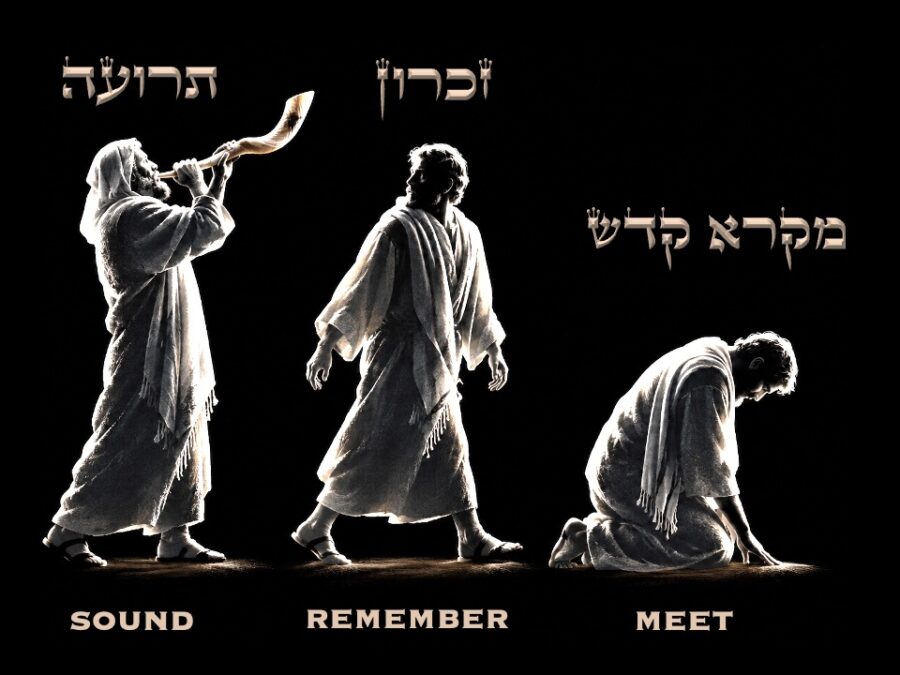
And so we are left with some fascinating questions. We are told this is a day of זִכְרוֹן, Zikaron, remembrance. But remembrance of what? We are commanded to sound a תְּרוּעָה, Teru’ah, a blowing, but why? What is the occasion? What is being announced? We are told to assemble for a מִקְרָא־קֹדֶשׁ, Miqra Qodesh, a holy convocation. But what is the assembly for?
The remarkable answer is: The Torah does not explicitly tell us. Jewish commentators themselves recognized the difficulty. Ibn Ezra, the revered medieval Jewish commentator, spoke of the mysteries surrounding this feast. About 350 years earlier, Abarbanel asked why the Torah does not explain the purpose of this festival. So the mystery is real. All of this makes Yom Teruah such a fascinating feast.
This lack of explanation is precisely what, over the centuries, opened the door to numerous traditions and interpretations surrounding this feast. Some of these traditions became so firmly established that, for many Jewish people today, it can be difficult to distinguish what the Torah actually says from what later Jewish tradition added.
Perhaps the clearest example is the very name by which the feast is now commonly known: Rosh Hashanah, רֹאשׁ הַשָּׁנָה, “Head of the Year,” or “New Year.” Over time, the first day of the seventh month came to be celebrated as the Jewish New Year and developed into one of Judaism’s great High Holy Days.
But many Jewish people may not realize this: The Torah never calls this feast Rosh Hashanah. In fact, according to the biblical calendar, this is not the first month. It is explicitly the seventh month of the Hebrew calendar year. Leviticus could hardly be clearer: “In the seventh month, on the first day of the month…” This is what we just read in vs.24. This feast provides an excellent starting point for understanding the distinction between biblical Judaism and the later developments of rabbinic Judaism.
Let us now look at the prophetic meaning of this feast and in relation to the Coming of the Messiah. Once again, what are we to remember, Zikaron? And what is the call, Teru’ah ? That brings us to this holy convocation called Miqra Qodesh.
Let us focus on the call first: the teruah. This word can refer to the sound of a shofar or trumpet, but it can also describe a loud shout or cry. Throughout the Hebrew Scriptures, teruah served as an alarm, a warning, a summons, or a battle cry. In Jeremiah, it announced approaching war. In Ezekiel, Amos, and Zephaniah, it appeared in contexts of battle and judgment.
So, when Israel heard the word teruah, it wasn’t necessarily peaceful background music. It was a sound that grabbed your attention. Wake up! Something is coming! Be ready!
Now notice where Yom Teru’ah stands in the calendar of the Feasts of the Lord. It is the first of the fall feasts. What comes next? Yom Kippur, the Day of Atonement. Yom Teru’ah sounds the alarm; Yom Kippur brings us face-to-face with sin, atonement, and judgment. Prophetically, that sequence is profoundly significant. First comes the trumpet. Then comes the judgment. Yom Kippur points us toward the coming time of Israel’s deepest affliction and national repentance, a period the prophets describe and the New Testament identifies as the great Tribulation.
Today, in Jewish tradition, Rosh Hashanah begins the Ten Days of Repentance, culminating in Yom Kippur, the Day of Atonement and judgment. Last week, I watched a short video in which a rabbi described Rosh Hashanah as a terrifying day. In fact, he repeated it three times. Why? Because, according to the traditional understanding he presented, this is the time when God judges humanity, with the judgment culminating at Yom Kippur. He was speaking primarily about personal judgment.
But the biblical prophets also speak powerfully about national judgment, particularly concerning Israel and the nations at the end of the age. And here is something we can certainly agree on: This is a time to repent. This is a time to seek God. This is a time to seek His way of salvation. Perhaps the language of Leviticus 23 is especially meaningful here. זִכְרוֹן, Zikaron: Remember! Remember what God has spoken. Remember His warnings. Remember His promises. Remember what the prophets have said about the day when humanity must stand before Him.
Then comes: תְּרוּעָה, Teru’ah: Sound the alarm! The prophets repeatedly use the trumpet to warn that danger and judgment are approaching. Then comes the third expression: מִקְרָא־קֹדֶשׁ, Miqra Qodesh: A holy Convocation. Gather before the Lord. And here we arrive at the great dividing line of Scripture. When God’s judgment comes, there are ultimately only two places to stand: with God, under His salvation and protection, or apart from Him, facing judgment without that refuge.
So the message of Yom Teru’ah is not merely ancient. Its cry still speaks: Prepare to meet your God. This is when Rosh Hashanah ultimately points us to the great question: Where can we find refuge when the judgment comes?