
 We have now reached a remarkable turning point in Paul’s defense of Israel in Romans 9–11.
Paul has taken us through Israel’s past, showing that Israel has always remained within God’s heart and purposes (through the remnant) and has been preserved by His faithfulness, because not one of His promises can fail. He then brought us into Israel’s present condition, explaining her relationship to the Gentiles and the Church, and warning the Gentile believers never to become arrogant toward the natural branches.
But now he turns our eyes toward Israel’s future. Suddenly, the great question becomes: How long will this present time continue before we see Israel’s future? How long will this history of dispersion, rejection, and persecution, spanning some 2,500 years, endure? How long will Israel experience this partial hardening? And when it ends, what will happen to Israel? And perhaps even more importantly, what will happen to the world when this part ends?
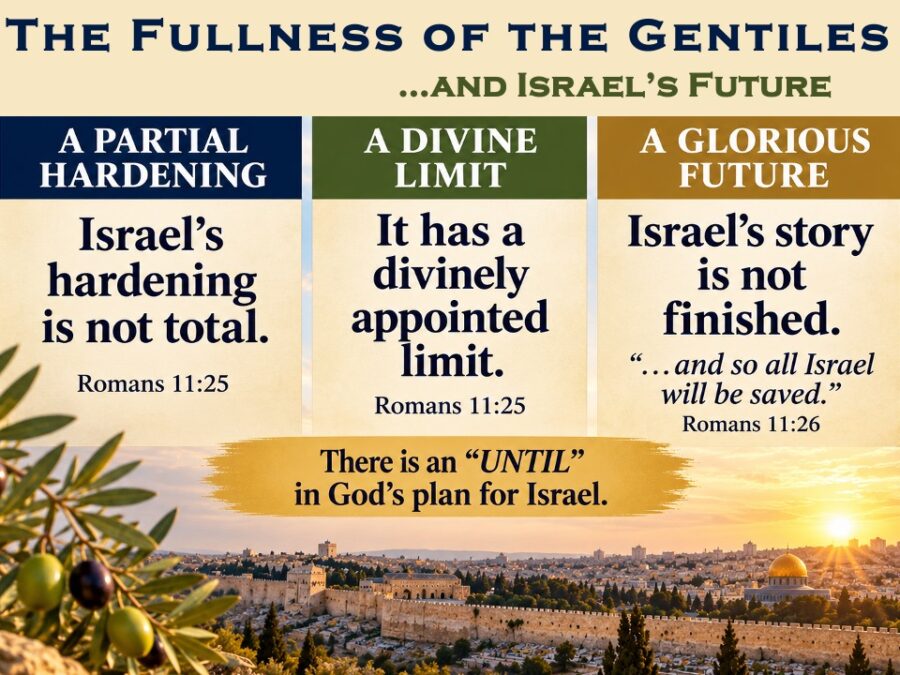
Paul introduces Israel’s future with one of the most extraordinary prophetic declarations in the entire letter: Romans 11:25–27. Here, Paul is about to reveal what he calls a mystery, something every Gentile believer needs to understand about Israel. What he is about to tell us is remarkable: Israel’s present hardening is partial, its present condition is temporary, and Israel’s story is not finished. Let us read the words of Romans 11:25-27, “For I do not want you, brethren, to be uninformed of this mystery, so that you will not be wise in your own estimation, that a partial hardening has happened to Israel until the fullness of the Gentiles has come in.”
Before we examine Paul’s answer, let us consider the word mystery as we commonly use it. Have we ever paused to consider what an extraordinary enigma Israel is? For the Bible believer, Scripture itself raises these questions. Why are there more than 2,000 references to Israel in the Bible? Why is such an enormous portion of the biblical narrative bound up with Israel, from Genesis to Revelation? More than 200 times, the God of Scripture is identified as “the God of Israel.” Israel is not a peripheral subject. It is woven throughout the biblical narrative.
Consider the numbers as well. There are perhaps 16 million Jewish people in a world of approximately 8.3 billion. That means the Jewish people represent only 0.2% of humanity. Think of it this way: In a room of 500 people, only one person would represent the Jewish share of the world’s population.
Yet for such a small number of people, comprising only two-tenths of one percent of humanity, their influence on human history has been extraordinary. Indeed, their influence has sometimes been so exaggerated or misunderstood that it has fed the old and poisonous conspiracy theory that the Jews are somehow attempting to control the world. The persistence of such accusations itself demonstrates how disproportionately large Israel appears in the imagination of the nations.
So now we come to the crucial question: What mystery had God kept hidden that Paul is now revealing? Romans 11:25 points to something extraordinary. The mystery is that Israel’s hardening is only partial, has a divinely appointed limit, and, in God’s sovereign plan, Israel’s future is tied to the fullness of the Gentiles coming in. In other words, Israel’s present condition is neither total nor permanent. There is an “until” in God’s plan for Israel: “A partial hardening has happened to Israel until the fullness of the Gentiles has come in.” What is the fullness of the Gentiles? These few words prompt us to consider so much of humanity’s history. The word fullness, pleroma, speaks of a totality, a completeness. We see this in Ephesians 1:10 when, in the fullness of time, Yeshua will be over all things. Colossians 2:9 speaks of the fullness of the deity, which is found in Yeshua Himself.
And here in Romans 11, we see Paul use the term fullness twice. In Romans 11:12, he speaks of the time when Israel will have attained her fullness and how the world will be blessed by it. “Now if their transgression is riches for the world and their failure is riches for the Gentiles, how much more will be their fulfillment (pleroma)?”
He also uses the same word, fullness, when speaking of the Gentiles. But what is it, and when would the fullness of the Gentiles occur? Is it when the last Gentile who is to believe comes to believe, and will this last one close the fullness of the Gentiles?
Many say that the Rapture will occur at the end of the age, when the church will be taken away from this world just before the Tribulation. They say that at this point, God has completed His work concerning the church’s earthly stay, and the focus will turn again to Israel. However, if we are to see the fullness of the Gentiles as including a full number, then we need to extend that time into the Tribulation itself. Many other Gentiles will be saved during that period. John speaks of a “great multitude which no one could number, of all nations, tribes, peoples, and tongues that comes out of the Tribulation.” Rev.7:9,14.
We also read in Matthew 24:14 where Jesus says concerning the period immediately preceding His return, “And this gospel of the kingdom will be preached in all the world as a witness to all the nations and then the end will come.” So the Fullness of the Gentiles is better placed at the end of the Tribulation.
In addition, the fullness also refers to something that has come to completion or reached its fullness. Paul spoke very pointedly about Gentile responsibility to provoke Jews to jealousy, to bring them back to the Lord. Why would that responsibility not continue throughout the Tribulation period, seeing that Yeshua, in Matthew 25, gives the judgment of the sheep and the goats? This is a judgment on the nations as to how they treated the “brethren of Yeshua” (the Jews) during this period. Gentile responsibility to bring the Gospel to the Jews and to treat them well continues until Yeshua’s return.
We also note that the fullness of the Gentiles falls within that period Yeshua calls the times of the Gentiles in Luke 21:24. The times of the Gentiles spans from the loss of Jerusalem and the Temple in 586 B.C. to the Second Coming of Yeshua. Today, Israel is still under the times of the Gentiles because, although it is a nation, it does not have jurisdiction over the Temple Mount. Jordan has it for now. This shows that the times of the Gentiles is still ongoing. The times and the fullness of the Gentiles will come to an end after the 70th week of Daniel 9:24-27, when Jesus comes back.
Go to the video – Romans 9-11- Part 7: Israel: Humanity’s Enigma