
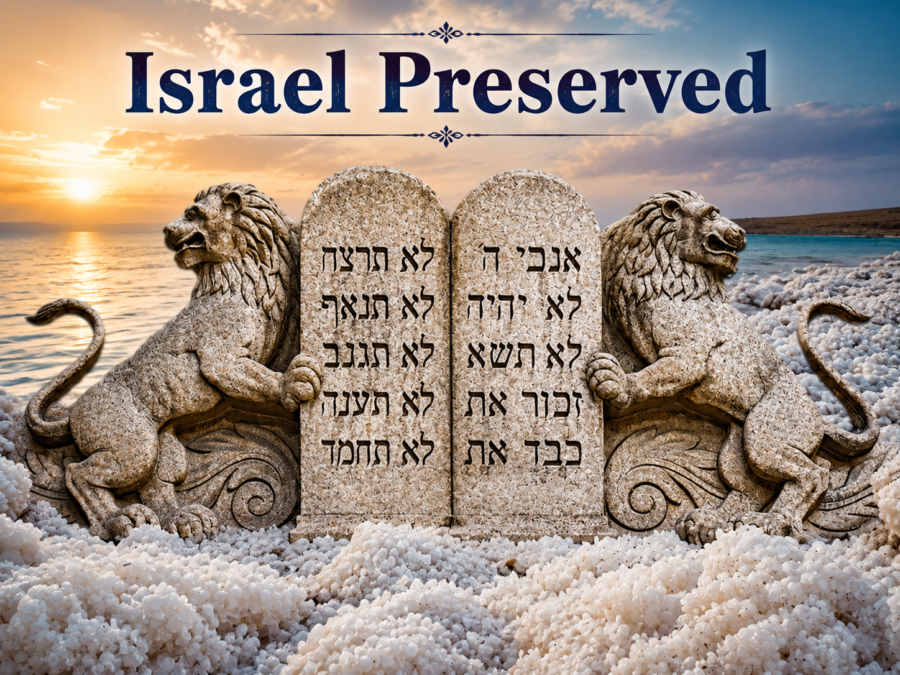
 Few books have shaped the history of Christianity as profoundly as the Book of Romans. Many have called it the very heart of the New Testament. And here, at the very center of this great book, lies a subject that many churches have neglected for centuries. That subject is Israel. Her past, her present and her future. And if there is one book in the New Testament that rises to defend, support, and uphold God’s purposes for Israel, it is the Book of Romans.
But Paul’s defense does not suddenly begin in Romans 9. In fact, Paul has been preparing his case long before he arrives at these chapters. Throughout the earlier chapters, he repeatedly refers to the Jew and to Israel.
So, it is in Romans 8 that he begins to build what may be his strongest argument. See how he does it; he begins by showing just how secure the believer is in God. His message is unmistakable; nothing and no one can separate us from the love of God. The structure of Romans 8 itself is remarkable. It begins with, “There is therefore now no condemnation for those who are in Messiah Jesus.” (Romans 8:1). It ends with, “Nothing shall be able to separate us from the love of God which is in Messiah Jesus our Lord.” (Romans 8:39). It begins with no condemnation. It ends with no separation.
And toward the end of the chapter, Paul asks three great questions, each beginning with the word “who?” Who will bring a charge against God’s elect? Who is the one who condemns? Who will separate us from the love of Messiah? (Romans 8:33-35). And the answer to each question is an emphatic “no one”. No accusation. No condemnation. No, nothing can separate God’s people from God’s promises.
But Paul is not finished. As if to remove every remaining doubt, he goes even further. In Romans 8:38-39 he lists ten realities: death, life, angels, principalities, things present, things to come, powers, height, depth, and finally, any other created thing. He then declares that not one of them has the power to separate God’s people from the love of God in Messiah Jesus.
This powerful chapter of Romans 8 is widely regarded in Christianity as one of the most loved, quoted and memorized, preached and influential chapters of the entire Bible. It has been called the Everest of the New Testament. This is the Christian’s victory chapter.
But then something remarkable happens. Without changing the subject and without taking a break, remembering that there were no chapter divisions in the original letter, Paul immediately begins Romans chapter 9. That is quite significant because the very next subject he addresses is Israel.
After proclaiming so boldly that God’s elect can never be separated from His love, Paul anticipates the obvious question; if that is true for believers, what about Israel? Have God’s promises to His chosen nation failed? Has God abandoned the people to whom belonged the covenants, the promises, and the Messiah Himself?
This is when we come to Romans 9:4-5 where in two verses, 8 advantages plus one in Romans 3:2 (the oracles / Word of God) are listed for Israel. Together there are 9 of them just like the 9 fruits of the Spirit in Galatians 5, or the 9 ministries of the believers in 1Corinthians 12.
This is what these two verses says in Romans 9:4-5, “Who are Israelites, to whom belongs the adoption as sons, and the glory and the covenants and the giving of the Law and the temple service and the promises, whose are the fathers, and from whom is the Messiah according to the flesh, who is over all, God blessed forever. Amen.”
A first thing we notice is that Paul is not speaking in the past tense, but in the present tense. Paul does not speak of Israel’s privileges as something that belonged to a bygone era. He does not say, “to whom belonged the covenants,” as though God had quietly changed the locks, moved the furniture out, and handed the keys to someone else.
Now Paul begins with the first privilege of Israel; the adoption. I love this because adoption was one of the great themes of the previous chapter. The flow of Paul’s argument is beautiful and deliberate. But notice that he approaches adoption differently in Romans 8 and Romans 9. In Romans 8, believers are told that they have received adoption. In Romans 9, Israel is said to possess the adoption. The verb changes. The believer receives the adoption. Israel possesses the adoption.
Let’s move to the eighth privilege of Israel, which is, of course, the greatest of them all; the Messiah Himself. Yeshua, Jesus, came from Israel, for He was a Jew. He is the descendant of Abraham and comes from the tribe of Judah. He was born in Bethlehem, just as the prophets had foretold. He was circumcised on the eighth day. He grew up in a Jewish home, worshipped in the synagogue, celebrated the Feasts of Israel, and taught from the Hebrew Scriptures. Throughout His earthly life and ministry, He lived as a Jew among His own people.
Yet His connection to Israel did not end with His ascension. According to the Scriptures, He will return to the very land from which He departed. He will return to Israel. His feet will stand upon the Mount of Olives, and from Jerusalem He will establish His kingdom and reign over all the earth. His connection to His earthly people and His earthly ministry will be remembered forever. Even heaven itself bears witness to this reality.
The eternal city is called the New Jerusalem. And upon its twelve gates are written the names of the twelve tribes of Israel. Throughout eternity, the redeemed of all nations will enter through gates bearing Jewish names. What a testimony to the faithfulness of God. Yeshua has not rejected Israel.
So then, considering these 9 privileges, we must ask ourselves, is it reasonable? Is it logical to despise the very people through whom God has given so much to the world? Today Israel is often the object of misinformation, hostility, and a hatred that seems strangely disproportionate to her size and influence. Paul saw the beginnings of this in his own day. He knew the Scriptures. He knew the prophecies. And he grieved deeply for his people.
And so today, perhaps more than ever, the Word of God calls us to pray for Israel and to stand with the Jewish people as they face increasing pressure and opposition. The Scriptures tell us that these tensions will not diminish as history moves toward its conclusion. But neither will God’s faithfulness diminish. For the gifts and the calling of God are irrevocable.
Go to the video – Romans 9-11 – The New Testament – Defense of Israel