
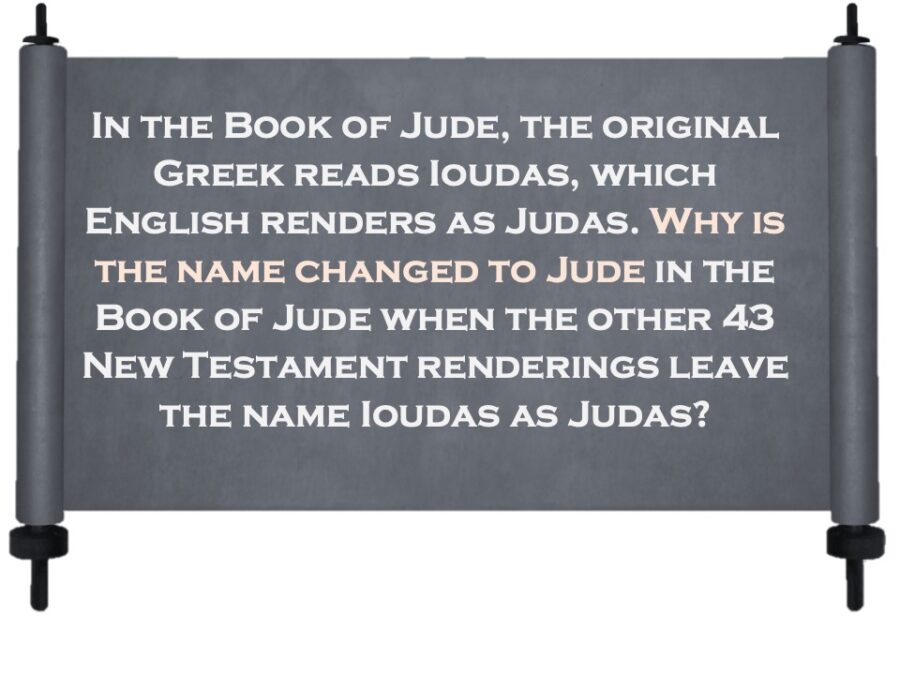
 1. Jude preferred to be called by his English name.
2. To avoid giving him too much notoriety and to prevent association with the Tribe of Judah,
since he was also the half-brother of Jesus.
3. Translators wanted to distinguish him from Judas Iscariot.
ANSWER: Number 3
In Greek, there is no distinction: Jude, Judas, and Judah ultimately represent the same Hebrew name, יְהוּדָה (Yehudah), rendered in Greek as Ἰούδας (Ioudas).
The earliest English Bibles did not consistently make this distinction. During the sixteenth century, English translators increasingly used “Jude” for the author of this epistle, thereby distinguishing him from the infamous Judas Iscariot. The Geneva New Testament of 1557 helped establish “Jude” as the conventional English name for both the epistle and its author, and the King James Version later continued that tradition.
Yet something was lost in the process. By changing Judas/Judah to Jude, the English reader can easily miss the remarkable biblical heritage of this name. Yehudah, Judah, is not a dishonorable name. Several men in the New Testament bear it. It is the name of Judah, one of the twelve tribes of Israel, from which the Messiah came. Revelation tells us that the name of Judah will endure into eternity, for the names of the twelve tribes are written on the gates of the New Jerusalem.
One infamous man should not be permitted to steal the honor of a noble biblical name. Evil cannot veto what God has called good. So when we open the little letter called Jude, we should remember that its author introduces himself with an ancient, deeply Jewish name: Ἰούδας, Yehudah, Judah.