
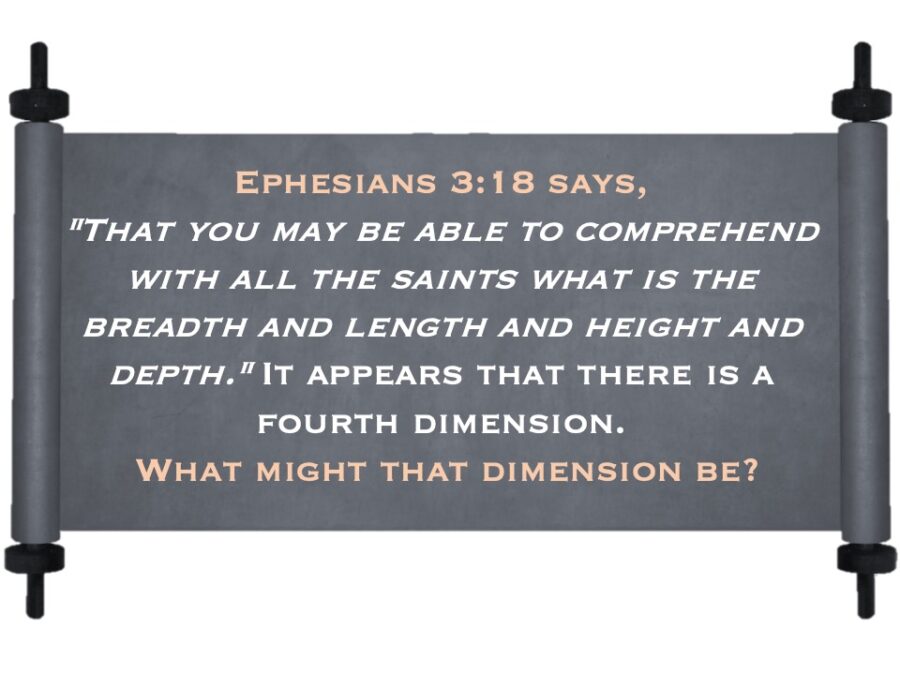
1. Eternity
2. Time
3. Not a literal fourth dimension, but a way of expressing the limitless love of the Messiah
Perhaps the answer is all of the above.
It is certainly possible that Paul was not proposing a literal fourth spatial dimension. Perhaps he was deliberately using four dimensions to describe something beyond ordinary human measurement: the immeasurable love of Yeshua and the vastness of God’s redemptive purpose.
Yet if Paul did intend an analogy to a fourth dimension, modern science provides an interesting comparison. Physicists commonly speak of time as the fourth dimension.
According to Einstein’s theory of relativity, the three spatial dimensions (length, width, and height) are united with a fourth coordinate, time. Together, they form what physicists call space-time. This theory became the foundation of modern cosmology and explains phenomena such as black holes, gravitational waves, and even the accuracy of the GPS systems we use every day.
Perhaps this even hints that eternity is beyond our present experience of time. Scripture may suggest that some form of sequence or duration continues in eternity, as seen in passages such as Revelation 8:1, where there is “silence in heaven for about half an hour,” and Revelation 22:2, where the tree of life bears fruit “every month.” So Paul hinted at this theory before Einstein, from one Jew to another.