
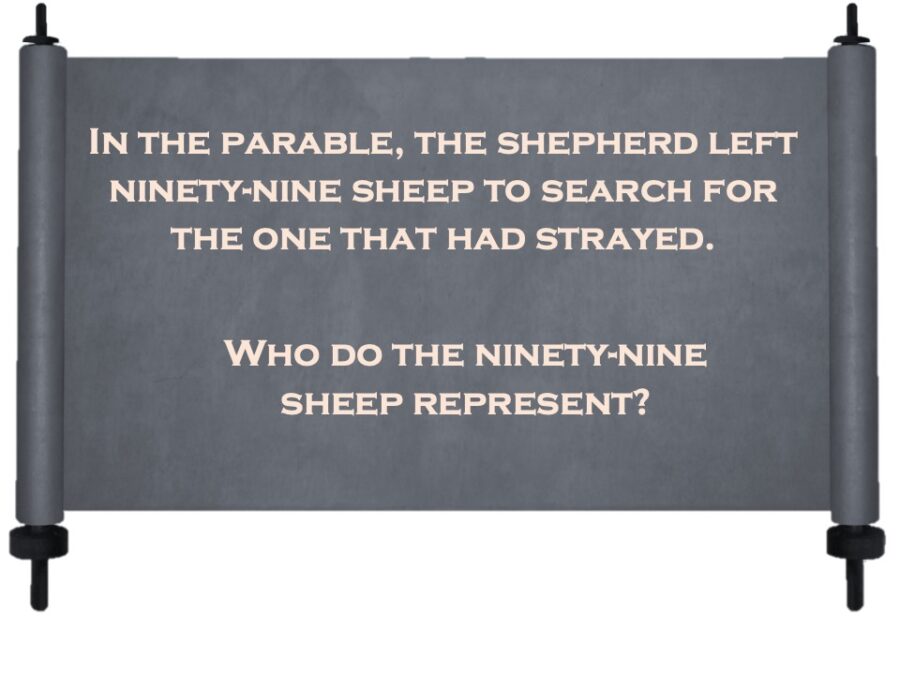
1. Other believers who remained safely within the flock.
2. Unbelievers who remained within the flock.
3. The ninety-nine represent different groups in the two parables: believers in Matthew and possibly self-righteous unbelievers in Luke.
4. The ninety-nine represent Israel, whereas the one lost sheep represents the Gentiles.
ANSWER: #3
Although the two parables are remarkably similar, their contexts suggest that Yeshua may have been referring to two distinct groups.
In Matthew 18:12–14, Yeshua speaks to His disciples (18:1). The context concerns the little ones who believe in Him (18:6). The ninety-nine sheep are described as those who have not strayed, while the shepherd searches for the one who has wandered away.
In Luke 15:3–7, however, Yeshua addresses the Pharisees’ and scribes’ criticism of His receiving sinners and eating with them (15:1–2). Here, the ninety-nine are described as “righteous persons who need no repentance” (15:7).
Could Yeshua be speaking ironically about religious leaders who considered themselves righteous and therefore saw no need to repent? If so, the contrast is striking: while these leaders believed themselves righteous, the sinner who recognized his need and repented became a cause for great rejoicing in heaven.
THE CONNECTION WITH EZEKIEL 34
An important parallel appears in Ezekiel 34:11–31, where the Lord describes Himself as Israel’s Shepherd.
He declares: “I will seek the lost, bring back the scattered, bind up the broken and strengthen the sick; but the fat and the strong I will destroy. I will feed them with judgment.” (Ezekiel 34:16)
Notice how the Lord speaks of the flock and distinguishes among different kinds of sheep. Some are lost, scattered, wounded, or weak, while others are strong and oppress the weaker sheep (34:17–22). Therefore, the Lord declares that He will judge between one sheep and another.
THE GREATER BIBLICAL PICTURE
This distinction aligns with Scripture’s broader teaching.
In Matthew 13:24–30, Yeshua describes the wheat and the tares growing together until the harvest.
Thus, within the visible covenant community, Scripture distinguishes between those who truly belong to God and those who do not. Although Matthew 18 and Luke 15 employ the same shepherd imagery, their distinct contexts may suggest two different applications:
- Matthew: The Shepherd’s concern for a believer who has wandered.
- Luke: The Shepherd’s joy over a sinner who repents, in contrast to those who consider themselves righteous.
Note that, in light of the answer above, choices 1 and 2 would also be correct if you make a direct connection between #1 and Matthew 18:12-14 and between #2 and Luke 15:3-7.
[/vc_column_text][/vc_column][/vc_row]